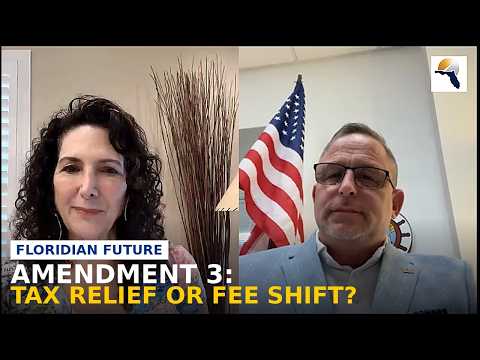
Amendment 3 sounds like “tax relief” — but what’s the real cost?
Guy Lalonde said it plainly: if you cut property taxes, the money doesn’t disappear; it shifts. That can mean fewer public se…Amendment 3 sounds like “tax relief” — but what’s the real cost?
Guy Lalonde said it plainly: if you cut property taxes, the money doesn’t disappear; it shifts. That can mean fewer public services, higher fees, and bigger rent increases—even for people who don’t own property.
Police, fire, 911, storm cleanup, roads, and parks aren’t “extras.” They’re services cities rely on every day.
If you care about real tax reform, don’t just read the headline. Read what gets left out.
#FloridianFuture #lakelandflorida #propertytax #floridapolitics #taxreform
Amendment 3 is being sold as a tax cut—but Jeff Brandes says the real story is a tax shift. Renters, small businesses, and small cities may end up paying for it.
What could get cut? Fire coverage, c…Amendment 3 is being sold as a tax cut—but Jeff Brandes says the real story is a tax shift. Renters, small businesses, and small cities may end up paying for it.
What could get cut? Fire coverage, community centers, libraries, parks, streetlights, and 911 dispatch. And if cities make up the gap with fees, renters, people on fixed incomes, and mom-and-pop businesses could feel the squeeze—even if they don’t get the benefit.
So this isn’t just about lower property taxes. It’s about who gets stuck covering the gap.
Worth thinking about before you vote. What do you think?
#FloridaPolitics #Amendment3 #PropertyTaxes #FloridaPolicy
Everyone's heard the headline. Almost nobody has read the fine print.
Amendment 3 raises Florida's homestead exemption to $150,000 in 2027 and $250,000 in 2028, caps non-homestead assessment growth at…Everyone's heard the headline. Almost nobody has read the fine print.
Amendment 3 raises Florida's homestead exemption to $150,000 in 2027 and $250,000 in 2028, caps non-homestead assessment growth at 5%, and sets up a path to eliminating homestead property taxes entirely. The pitch: lower taxes, more money in your pocket.
The reality: state economists put the recurring revenue loss near $12 billion - and that money doesn't evaporate. It moves. Onto renters. Onto small businesses. Onto the neighbors who didn't get the break. And onto the cities themselves.
Former State Senator Jeff Brandes (14 years in the Florida Legislature, Army veteran, founder of the Florida Policy Project) went city by city through all 24 Pinellas municipalities and modeled what this looks like on the ground - not in Tallahassee talking points.
In this episode:
- What Amendment 3 actually says vs. what voters think it says
- The "fifth homestead exemption" provision that creates two classes of Floridians
- Why the "core services" language is a provision "you could drive a Mac truck through"
- The Pinellas 24, city by city - Kenneth City, South Pasadena, Gulfport, the Redingtons, the Belleairs
- Why cities can outsource the service but cannot outsource the bill
- The Pinellas Sheriff already contracts police to 13 municipalities - what happens when contract prices rise
- How non-ad valorem fees hit longtime homeowners harder than their current tax bill
- The affordable housing trap: why commissioners may stop approving entry-level homes entirely
- "Do I want a Costco or a cul-de-sac?"
- Home rule, the Tallahassee trust fund, and who sets the rules once cities need a bailout
His line: "Imagine a doctor gave his healthiest patients and his sickest patients the exact same medicine. For the sickest, the side effects might be worth it. For the healthy, we have a word for that malpractice."
Chapters:
00:00 Intro - The Fine Print
02:00 What Amendment 3 actually does
05:00 The "probationary Floridian" clause
07:00 Core services and the catch-all
08:45 The Pinellas 24, city by city
11:20 Why county budgets aren't what you think
15:25 Where the money goes instead - non-ad valorem
17:30 The affordable housing trap
22:00 Home rule and the trust fund
29:30 The first domino
32:45 Who's backing this, and why
36:00 "Malpractice"
Research & sources:
Florida Policy Project - floridapolicy.org
Florida League of Cities - flcities.com/propertytaxes
Subscribe to Floridian Future for plain-English breakdowns of the policy that actually hits your wallet.
The draft originally said 30 days. Then Flock said publicly that they purge in seven. So the pledge now says seven.
That is the Contract for Community: a warrant based on probable cause before govern…The draft originally said 30 days. Then Flock said publicly that they purge in seven. So the pledge now says seven.
That is the Contract for Community: a warrant based on probable cause before government agents reach your data held by third parties, no tracking of law abiding people by Flock cameras or automated license plate readers without specific suspicion or judicial oversight, Florida surveillance data stored on Florida servers, no handoff to a federal database without a warrant naming the individual, and automatic deletion in seven days absent an active investigation.
Four statewide candidates are being asked to sign.
ContractWithFlorida.com
#fourthamendment #flocksafety #ALPR #privacy #surveillance #florida #floridapolitics
"You can't hide things from the parents about what's going on in a child's life."
Florida already has some of that in law. The Contract for Children asks the next set of statewide officials to keep i…"You can't hide things from the parents about what's going on in a child's life."
Florida already has some of that in law. The Contract for Children asks the next set of statewide officials to keep it and build on it: curriculum transparency, trade and technical pathways as real options, and education dollars that follow the student to whichever school a parent picks.
Four statewide candidates are being asked to sign. The list of who has and who has not is public.
ContractWithFlorida.com
#ParentalRights #SchoolChoice #Florida #Education #FloridaPolitics
"This does not take away anyone's right to use digital programmable money. Go for it."
The Contract for Commerce asks candidates to commit to three things: government and public sector entities must …"This does not take away anyone's right to use digital programmable money. Go for it."
The Contract for Commerce asks candidates to commit to three things: government and public sector entities must accept cash for taxes, fees, fines, and services, Floridians can never be forced or coerced into digital programmable money, and any programmable currency bill without explicit protections for Floridians gets opposed.
The timing argument is the real one. Once cash stops working, there is nothing left to legislate about.
Full contract and signatures: ContractWithFlorida.com
#CashIsFreedom #CBDC #Florida #SoundMoney #FloridaPolitics #FinancialFreedom
"The man has a backbone."
All four statewide candidates are being asked to say where they stand on Dr. Joseph Ladapo continuing as Florida's Surgeon General, and to sign the Contract for Care: no gov…"The man has a backbone."
All four statewide candidates are being asked to say where they stand on Dr. Joseph Ladapo continuing as Florida's Surgeon General, and to sign the Contract for Care: no government mandate requiring a medical procedure, vaccination, or treatment as a condition of employment, education, or participation in public life, and no repeal or weakening of Florida's existing medical freedom protections.
Candidates answer questions like this when voters keep asking them.
Full contract and signatures: ContractWithFlorida.com
#Ladapo #Florida #MedicalFreedom #SurgeonGeneral #FloridaPolitics
Amendment 3 is on Florida's ballot this November - and the headline sounds great. Raise the homestead exemption, cut your property tax bill, put money back in your pocket. But what happens when the re…Amendment 3 is on Florida's ballot this November - and the headline sounds great. Raise the homestead exemption, cut your property tax bill, put money back in your pocket. But what happens when the revenue disappears?
In this episode of Floridian Future, host Saga Stevin sits down with Lakeland City Commissioner Guy LaLonde Jr. - Navy veteran, 30-year Publix leader, small business owner, and the man who actually votes on the city budget - for a plain-English breakdown of what Amendment 3 would do to city services.
We get into:
How a city budget is actually built - and why a $900 million budget is really a $203.9 million general fund
The millage rate - why Lakeland hasn't raised it in 10 years, and why that matters here
The $43 million shortfall Lakeland faces if the amendment passes
The spending restrictions in the amendment - and what falls outside them
Why public safety protections were removed between the original bill and the special session version
Who actually pays - renters, mobile home residents, and new Florida residents
The fee shift - why "tax relief" may end up costing you more
Real tax relief vs. a good first draft - what Commissioner LaLonde says he could support
This isn't a partisan pitch. It's a sitting commissioner walking through the arithmetic.
Timestamps
00:00 — Intro: the headline vs. the details
02:00 — Guy's background: New Hampshire, the Navy, and why Lakeland
04:45 — Operation Earnest Will and what it taught him about risk
06:50 — How a city budget works, explained like you're five
09:45 — The millage rate: 10 years, no increase
11:20 — Why the amendment is "a great first draft"
12:30 — What got removed: police, fire, and 911
13:45 — Breaking down the general fund: $35.8M fire, $72.7M police
16:40 — The $43 million shortfall
17:15 — Where could cuts actually come from? Public-private partnerships
19:40 — What "essential" really means
21:30 — Why not the same urgency on homeowners insurance?
23:45 — What looks discretionary but isn't
26:05 — Street lights, parks, and quality of life
29:00 — What he'd tell a homeowner who wants to vote yes
32:40 — Renters and affordability: the group nobody's talking about
35:00 — Minimum wage, prices, and the middle class squeeze
36:55 — The view from a small business owner
41:35 — Cash, local business, and keeping dollars in Lakeland
44:05 — Closing thoughts
What does a school board actually do? Most voters couldn't tell you — and that's the problem.
In this episode of Floridian Future, Saga Stevin sits down with Kate Wallace, a member of the Polk Count…What does a school board actually do? Most voters couldn't tell you — and that's the problem.
In this episode of Floridian Future, Saga Stevin sits down with Kate Wallace, a member of the Polk County School Board, to break down the job in plain English.
Kate was appointed in 2025 by Governor DeSantis to fill the seat left by Rick Nolte's passing. She's a Bartow native, a product of Polk County Public Schools, and spent 20 years in education policy before taking the seat.
We cover:
The board's three real powers — and what it doesn't control
Why Polk County is one of the largest school districts in America
How a single vote on a seven-member board actually matters
The book challenges, opt-in vs. opt-out, and who shows up
The one-mill property tax measure on the November ballot
IDEA Public Schools, 3DE, and what charter and district schools can learn from each other
Why 50% of kids still can't read on grade level
What to look for when you vote for a school board member
This is a civic education episode. No jargon left unexplained. If you've ever wondered where your school tax goes or what your school board is actually responsible for, this is for you.
Contact Kate Wallace: kate.wallace@polkschoolsfl.net
🔔 Subscribe for more Floridian Future — breaking down how government actually works for everyday Floridians.
Chapters:
0:00 – Intro
1:15 – What a school board does
4:00 – The board's three powers
8:30 – What the board doesn't control
11:00 – How one vote matters
12:30 – Book challenges and opt-in vs. opt-out
24:00 – The one-mill tax on the November ballot
29:00 – IDEA Public Schools and 3DE
38:00 – What Kate wants to change
45:00 – Closing thoughts
Floridian Future is a civic education podcast helping everyday Floridians understand how their government works.
This conversation is about more than your driver's license. It's about privacy, power, transparency, and the state we call home.
State Representative Peggy Gossett-Seidman (House District 91 - Boca Ra…This conversation is about more than your driver's license. It's about privacy, power, transparency, and the state we call home.
State Representative Peggy Gossett-Seidman (House District 91 - Boca Raton, Highland Beach) joins Floridian Future to connect the dots on issues most politicians keep in separate boxes.
We cover:
Your Data, Sold for a Penny
Florida has made nearly $490 million selling driver records - names, addresses, birth dates, photos, organ donor status
Data brokers layer on your credit, mortgage, military history, family, and buying habits
Recent breaches: hundreds of thousands of Florida records accessed, allegedly overseas
Her Driver Privacy Act died without a single committee hearing
Your Fourth Amendment
Why the 1992 law behind this is obsolete in the AI age
The Real ID question: should it be optional?
License plate readers, FDOT pulling cameras off state highways, and the grassroots backlash
"Get a warrant" - what due process actually looks like
Epstein & Transparency
How she got the sealed Palm Beach grand jury records released
What it took, and why it mattered
Why she refuses to let buried records stay buried
The Real Florida
The State Park Preservation Act - and the Michigan golf course that almost became Florida's future
Florida's one-of-a-kind ecosystem: the aquifer, the springs, the Everglades, the barrier islands
Why overdevelopment and deep water injection put our water at risk
Education & the Trades
Why "everyone needs a college degree" was a costly mistake
Bringing back civics, cursive, and skilled work
The debt trap vs. the trades
What You Can Do Right Now
Practical steps to protect your data today
How to contact your state representative and support the Driver Privacy Act
Contact Rep. Gossett-Seidman: Peggy.Gossett-Seidman@flhouse.gov